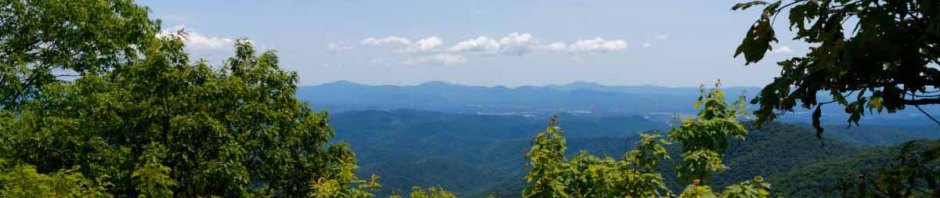
In 1896, George Vanderbilt welcomed his first guests to Buckspring Lodge. Its rustic style mirrored that of the Adirondack Great Camps. Vanderbilt’s version included a main lodge, dining hall/kitchen, stable and Rangers Quarters for staff who patrolled his land holdings. Today’s Mount Pisgah Picnic Area marks the location of the compound’s tennis and croquet courts, garden, orchard, apiary and livestock.
The main lodge was anchored by a thirty-foot-square sitting room. A six-foot-high fireplace opening dominated the south wall. A doorway on the north and south wall each led to a bedroom suite. Upstairs, the library’s wall extended over the east porch providing cliffside views. French doors opened onto the dining hall’s covered porch. A pedestrian bridge spanning the stable courtyard connected the kitchen to the upper floor of Rangers Quarters.
Midway Cottage was added in 1903 between the main lodge and dining hall/kitchen. A covered walkway connected all three buildings. In 1911, a meetinghouse in the Hominy Valley village of Stony Fork was disassembled, hauled to a building site north of the main lodge and fashioned into a bungalow known as Honeymoon Cottage. Rangers Cabin – the compound’s final addition in 1912 – served as the caretaker’s residence overlooking the entry gate.
A visit to Buckspring Lodge began with a horseback ride on public roads to Bent Creek Gap, and then on bridle paths up Pisgah Ridge. Luggage and staff accessed the compound from Cruso on a primitive wagon road. Completion of Vanderbilt Motor Road in 1910 made the lodge accessible by car. Departing Stony Fork, motorists climbed Pisgah Ridge on a graded roadbed and then followed a widened bridle path from today’s Elk Pasture Gap to Buck Spring Gap.
An eight-foot-high stone dam impounds a Pisgah Creek tributary downslope from Mount Pisgah Picnic Area. A motorless ram pump installed near the dam in 1896 lifted water to a holding tank above the main lodge’s west porch. A Pelton wheel turbine installed downstream from the dam in 1911 provided hydroelectric power. Years later, a gas-powered generator supplanted the Pelton wheel. Rural electrification came to Buckspring Lodge in the 1950’s.
Two months after Vanderbilt’s death in March 1914, his widow Edith sold the entire eastern slope of Pisgah Range – 86,700 acres – to the U.S. Forest Service but retained 470 acres inclusive of Buckspring Lodge. After Edith’s death in 1958, grandson George Cecil inherited the aging compound. Months later, Cecil sold Buckspring Lodge to the State of North Carolina who granted the U.S. Department of Interior a 7,000-foot right of way which enabled the Blue Ridge Parkway to pass through.
The National Park Service scheduled Buckspring Lodge for demolition in 1961 but allowed Cecil to remove two accommodations. Honeymoon Cottage, known today as “Buck Spring Cabin,” stands in The Ramble of Biltmore Forest. A cornerstone salvaged from the main lodge lies nearby. Its barely legible inscription reads, “GWV 1896.” Rangers Cabin became the home of Biltmore Farms truck driver Bob Allen. In 2015, his heirs donated Rangers Cabin to Biltmore Estate. Today, it serves as Antler Hill’s Outdoor Adventure Center. The springhouse remains standing downslope from the courtyard.
Bart Paschal
August 2026
Other Resources

