
Don’t look for Clubmosses in your moss books! Neither ferns nor mosses, Clubmosses are called “Fern Allies”, and often found in the back of fern books. Fern Allies are a group of seedless vascular plants that, like ferns, shed spores to reproduce. Other types of Fern Allies include the Horsetails (Equisetum), Quillworts (Isoetes), & Spikemosses (Selaginella). Clubmosses typically look like miniature trees, and their common names often reflect this observation. Clubmosses are divided into 3 genera, Huperzia, Lycopodiella, and Lycopodium. We see Clubmosses on almost every walk we take. Those that we most commonly see on our hikes in North and South Carolina are shown below. Click on any picture to zoom.
HUPERZIA

Gemmae located at base of upper leaves
Huperzia species bear 2 different types of leaves: sporophylls (which contain sporangia), & trophophylls (the vegetative leaf that undergoes photosynthesis). Unlike other Clubmosses, Huperzia have no true horizontal stems, although older plants may lean over and root. Reproduction in Huperzia also differs from the other Clubmosses. It can occur vegetatively by shedding bulblets or plantlets called gemmae. These develop at the base of the leaves on the upper stems & when mature fall to the ground to produce new plants. Sexual reproduction occurs when spores are released from the sporangia. Two different types of Huperzia are found in the Southern Appalachians:
Huperzia appalachiana
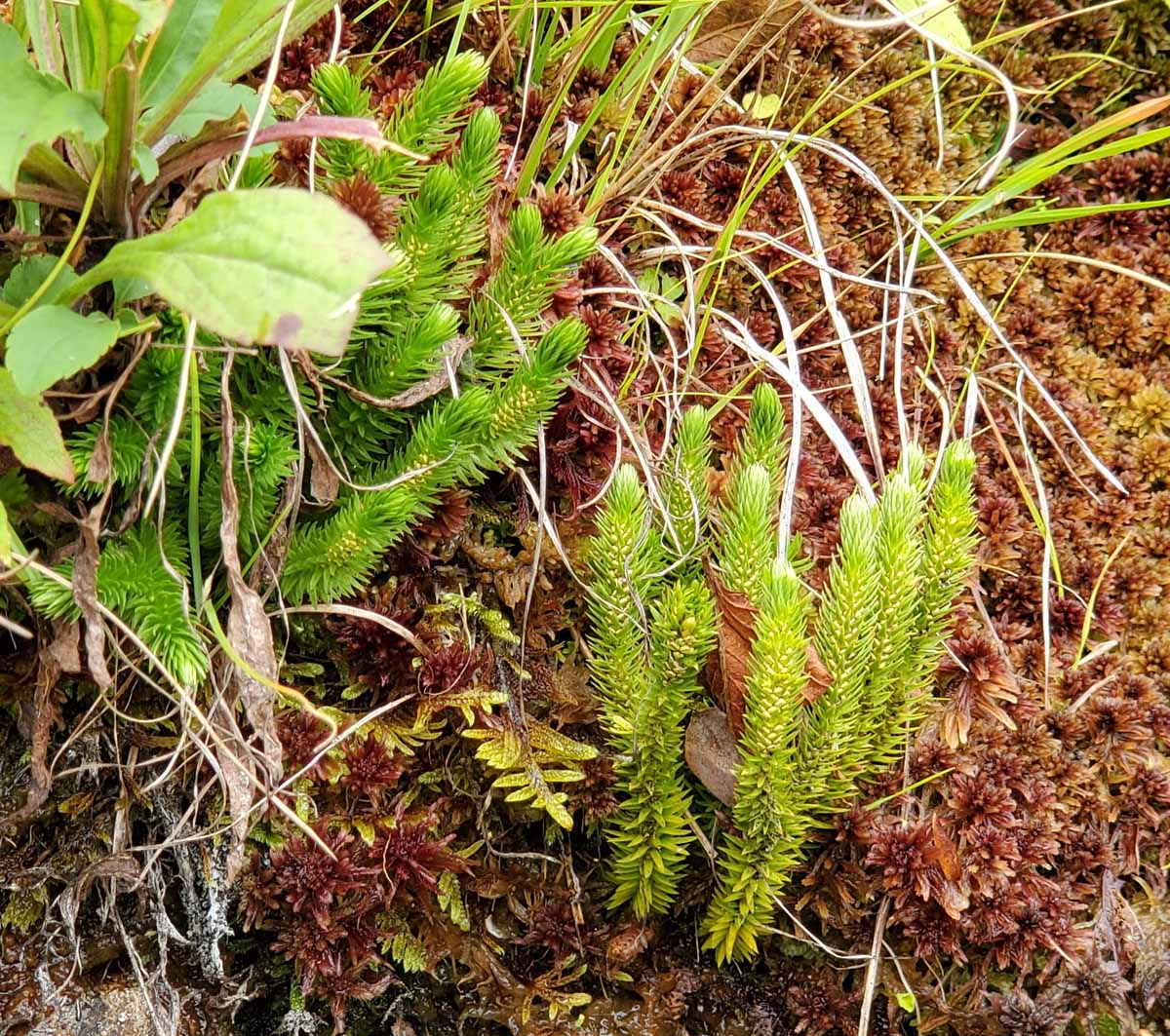
- Common Names: Appalachian Clubmoss; Mountain Firmoss
- Location: High elevations, usually >6,000 feet, in rock crevices; uncommon
- Form: Evergreen. Grows in small clumps in a spreading circle. Lance-shaped toothless leaves are arranged in tight bushy spirals around the stem. Similar to Huperzia lucidula, but smaller & not shiny, & stomates (air pores) are found on both upper & lower surfaces of leaves. Gemmae are scattered along the upper stem, not clustered at the top like Huperzia lucidula
- Reproduction: Vegetatively by release of gemmae from base of leaves at the upper portion of the stem. Sexually by spores released from sporophylls
- Derivation of Scientific Name: For German botanist, Johann Peter Huperz, & “found in the Appalachians”
Huperzia lucidula

- Common Names: Shining Clubmoss; Shining Firmoss
- Location: Low- to mid-elevations especially in moist Hemlock woods; common
- Form: Evergreen. Distinctive. Lance-shaped shiny leaves with small teeth are widest towards the tip. Stomates (air pores) are found on only the lower leaf surface. Annual constrictions along the stem of alternating bands of sporophylls & trophophylls give the plants an irregular or undulating appearance. Gemmae are clustered at the top of the stem
- Reproduction: Vegetatively by release of gemmae & sexually by spores released from sporophylls
- Derivation of Scientific Name: Meaning “glossy, clear or shining”
LYCOPODIELLA
As you might guess from the common name, Bog Clubmoss, Lycopodiella species prefer wet, boggy conditions. The only one we see on our field trips is Lycopodiella appressa (Southern Bog Clubmoss) at Ashmore Heritage Preserve, where the plants that grow at the edge of Lake Wattacoo are sometimes underwater!
Lycopodiella appressa

- Common Name: Southern Bog Clubmoss; Slender Clubmoss
- Location: Low elevation bogs, marshes, and other wet locations; uncommon
- Form: Deciduous. Slender leafy horizontal stems creep along the ground, rooting throughout. Both fertile & non-fertile stems are covered with leaves
- Reproduction: Upright stems are fertile with strobili (the region of the stem that bears spores) located at the tip.
- Derivation of Scientific Name: From Lykos for “wolf” and podion for “foot” & “pressed close to or lying flat against”
DENDROLYCOPODIUM
Dendrolycopodium species were previously included in the genus Lycopodium. They have erect to semi-erect leafy branched stems & a tree-like appearance.
Dendrolycopodium obscurum (Lycopodium obscurum)
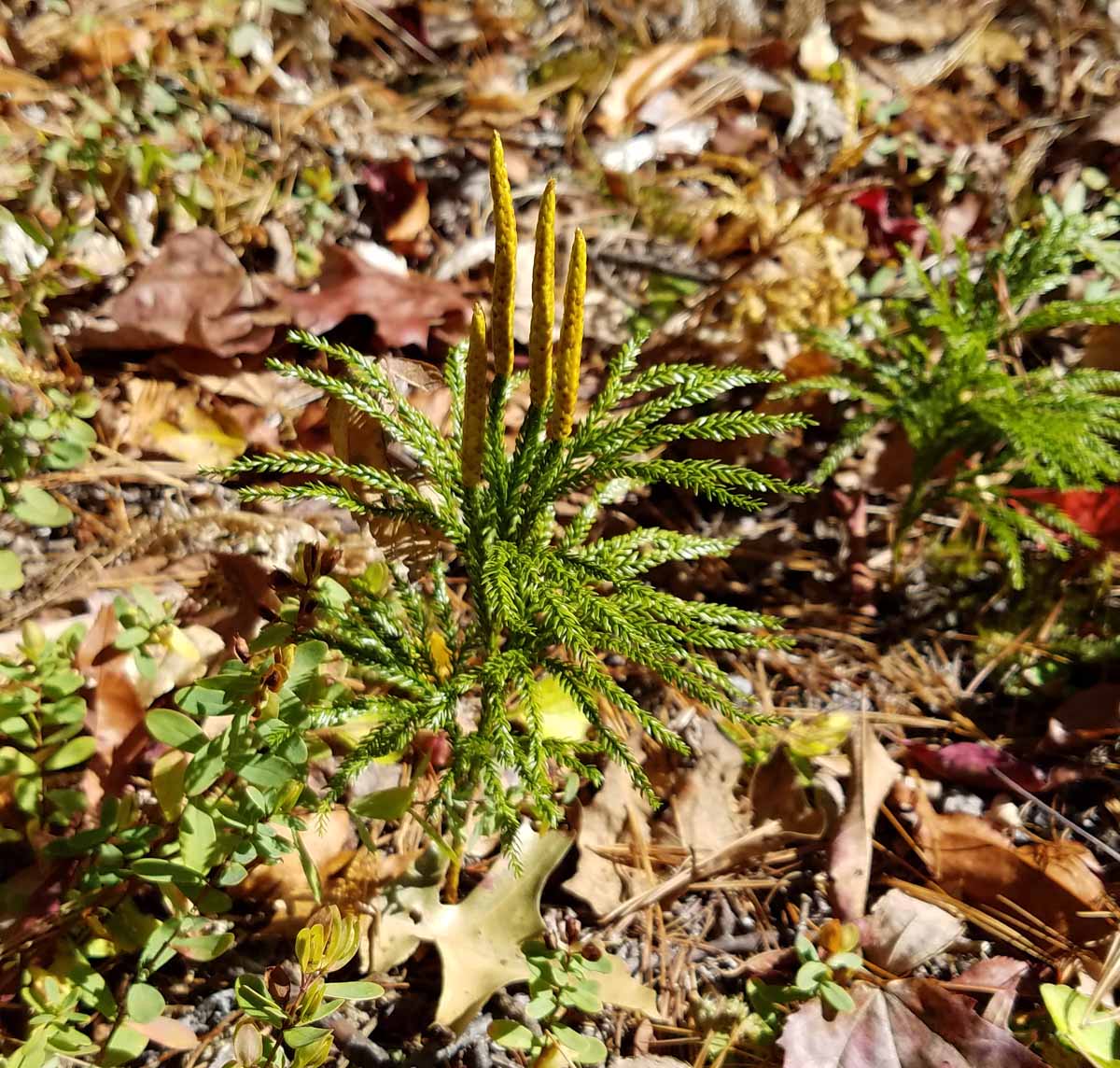
- Common Names: Ground Pine; Rare Clubmoss; Princess Pine
- Location: Mid- to high-elevations; common
- Form: Evergreen. Erect stems branch upwards several times, resembling small trees. Needle-like leaves with pointed tips
- Reproduction: Stromboli on short stems at the ends of branches
- Derivation of Scientific Name: From Dendron meaning “tree”, Lykos for “wolf”, & podion for “foot” & “club-shaped”, & “hidden”, referring to its deep-buried rhizome
DIPHASIASTRUM
Diaphasiastrum species were previously included in the genus Lycopodium.
Diphasiastrum digitatum (Lycopodium digitatum)

- Common Names: Fan Club Moss, Southern Ground-cedar
- Location: Mid- to high elevations in acid forests & openings; very common
- Location: Evergreen. Vertical stems with fan-like branches
- Reproduction: Erect stems fork twice to bear 4 strobili
- Derivation of Scientific Name: From Diphasium and astrum for “incomplete resemblance” & “branchlets resembling fingers”
Diphasiastrum tristachyum (Lycopodium tristachyum)

- Common Names: Ground Cedar; Blue Clubmoss; Blue Ground-Cedar; Ground Pine; Deep-rooted Running-pine
- Location: Mid- to high elevations in open woods & rocky areas; uncommon
- Location: Evergreen. Multiple blue-green branches in an ascending cone
- Reproduction: Erect stems fork twice to bear 4 strobili
- Derivation of Scientific Name: From the Greek treis for “three” and stachys for “ear of corn”. Possibly for the arrangement of 3 peduncles per stalk
LYCOPODIUM
Lycopodium clavatum

 Common Names: Running Clubmoss; Common Clubmoss; Stag’s-horn Clubmoss; Ground Pine
- Location: Low to high elevations in open woods, fields, & thickets; common
- Form: Evergreen. Distinctive. A forking, round & bushy creeping horizontal stem runs along the ground, although on McCall Cemetery loop we have seen it climbing a tree!
- Reproduction: Erect strobili-bearing stems emerge from the tips of the horizontal stems
- Derivation of Scientific Name: From Lykos for “wolf” & podion for “foot” & “club-shaped”

Lycopodium digitatum see Diphasiastrum digitatum
Lycopodium hickeyi

- Common Names: Pennsylvania Clubmoss; Hickey’s Tree Clubmoss
- Location: Generally above 4,000 feet in open woods, balds, or rocky areas; uncommon
- Form: Evergreen. Lycopodium hickeyi has leaves that are all the same size and do not twist. It is more often found in drier and sandier sites than the other tree-Clubmosses
- Reproduction: Erect stems bearing 2 or 3 strobili emerge from branches of the horizontal stems
- Derivation of Scientific Name: For R. James Hickey, Professor of Biology at Miami University, Ohio
Lycopodium obscurum see Dendrolycopodium obscurum
Lycopodium tristachyum see Diphasiastrum tristachyum
Photography by Ken Borgfeldt, Penny Longhurst, & Joe Standaert
Sources:
Cobb, Boughton, Farnsworth, Elizabeth, & Lowe, Cheryl: A Field Guide to the Ferns and their Related Families. Northeastern & Central North America. Second Edition. Houghton Mifflen Company, 2005.
Evans, Murray: Ferns of the Smokies. Great Smoky Mountain Association. 2005.
Gledhill, David : The Names of Plants. Cambridge University Press; 4th Edition, 2008.
NamethatPlant.com – Lycopodium
Snyder, Lloyd H., Jr. & Bruce, James G.: Field Guide to the Ferns and Other Pteridophytes of Georgia. University of Georgia Press, 1986.
 Western Carolina Botanical Club