Cornaceae family members formerly in the genus Cornus have recently been divided into four different genera: Benthamidia, Chamaepericlymenum, Cornus, and Swida. The Cornaceae species found in the Southeastern United States are described below.
Genus: Big-bracted Dogwoods (Benthamidia)
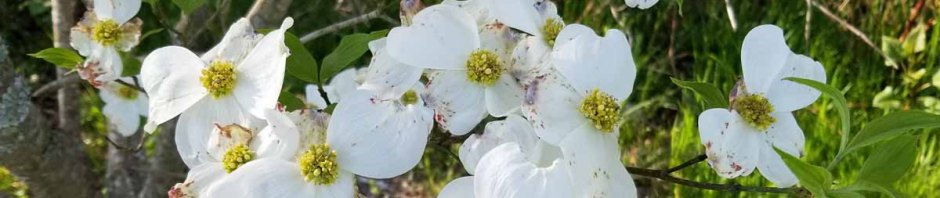
We are all familiar with the Big-bracted Dogwoods. These members of the Benthamidia genus have large white petal-like bracts surrounding small central flowers.
Flowering Dogwood (Benthamidia florida)


- Synonym: Cornus florida.
- Location: Native and common in woodlands & forests.
- Form: Small deciduous tree with checkerboard-like scales on the trunk bark.
- Flowers: Large white petal-like bracts surrounding small central flowers.
- Leaves: Opposite and elliptical with short petioles and prominent veins.
- Fruit: Bright red ripe fruit, attractive to birds and critters, appears in clusters.
- Derivation of Scientific Name: From cornu for “horn”, Benthamidia in honor of the English botanist George Bentham, and from florida for “flowering”.
Kousa Dogwood (Benthamidia japonica)


- Synonym: Cornus kousa.
- Location: Non-native but commonly used in landscaping.
- Form: A larger and sturdier tree than Flowering Dogwood.
- Flowers: Creamy-white petal-like bracts surround small central flowers.
- Leaves: Longer and narrower than Flowering Dogwood.
- Fruit: Large compound fruit that changes from green to red when ripe.
- Derivation of Scientific Name: From the Japanese word for this tree.
Genus: Dwarf Dogwood (Chamaepericlymenum)
Bunchberry (Chamaepericlymenum canadense)


- Synonym: Cornus canadensis.
- Location: Native to Northern States and Canada, but not North Carolina.
- Form: Low-growing ground cover.
- Flowers: Four large white bracts surround the central flowers.
- Leaves: In whorls around the stem.
- Fruit: Round bright red ripe fruit.
- Derivation of Scientific Name: Refers to its usual Northern or Canadian location.
Genus: Dogwood (Swida)
Alternate-leaved Dogwood (Swida alternifolia)


- Synonym: Cornus alternifolia.
- Location: Native and common in the mountains but rare elsewhere in the Carolinas.
- Form: Deciduous shrub or small tree. Found in moist or dry woodlands or along stream banks.
- Flowers: Multiple flowers have small white or cream-colored petals on each flat-topped cyme.
- Leaves: Alternate with long petioles and usually clustered near the twig tips.
- Fruit: Colored black/blue and borne on red stems.
- Derivation of Scientific Name: Referring to the alternate arrangement of the leaves.
Silky or Swamp Dogwood (Swida amomum)


- Synonym: Cornus amomum.
- Location: Native to eastern USA and Canada. Prefers to grow in damp areas and is often used for stream restoration projects.
- Form: Medium to large-sized deciduous shrub with multiple stems and reddish twigs with silky hairs.
- Flowers: Narrow white petals with a colored ovary often seen in the center of the flower.
- Leaves: Leaf undersides have silky hairs.
- Fruit: Shiny blue.
- Derivation of Scientific Name: May refer to the shape of the leaves.
Sources:
Lance, Ron: Woody Plants of the Blue Ridge, pgs. 19 & 30, 1994
Swanson, Robert E.: A Field Guide to the Trees and Shrubs of the Southern Appalachians. The Johns Hopkins University Press, p. 299-301, 1994.
Vascular Plants of North Carolina
Alan S. Weakley & S.E. Flora Team: Flora of the Southeastern United States. Key to Cornaceae. UNC Herbarium, 2025.
 Western Carolina Botanical Club