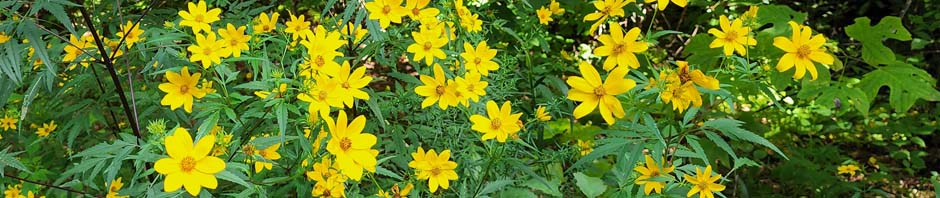
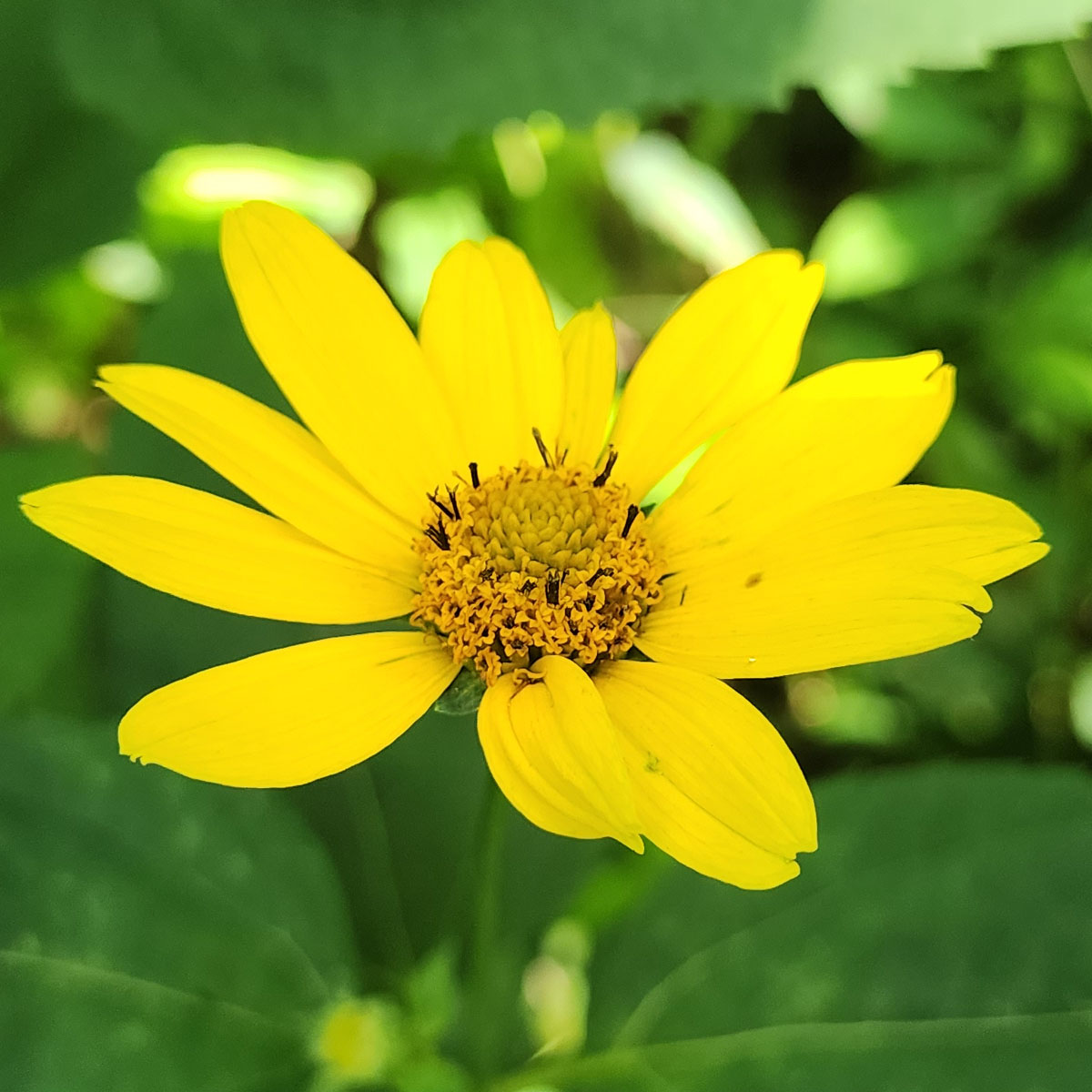
This winter we’re categorizing plants in our database by family. This week’s post continues with more plants in the Asteraceae (Daisy or Sunflower) family, the second largest flowering plant family in the world after the Orchidaceae family. Asteraceae are also known as composites because their flowerheads are composed of multiple flowers. Asteraceae plants may have one or both of two types of flowers, disk & ray. Ray (petal-like) flowers are what we typically notice when we look at a plant. Disk flowers are formed from 5 tiny petals fused to produce tubes. The Daisies shown here have radiate flowerheads containing disk flowers located in the center of the flowerhead surrounded by ray flowers. Our previous post covered the Asteraceae tribes Cardueae (Thistles with only disk flowers) & Cichoroideae (Chicories, Dandelions, & Lettuces with only ray flowers).
-

- Asteraceae tribe Cardueae – Tubular Disk Flowers
-

- Mountain Cynthia (Krigia montana) Asteraceae tribe Cichoroideae – Ray Flowers
-
- Asteraceae – Both Disk & Ray Flowers
Photography by Ken Borgfeldt, John Colson, Richard Holzman, Mary Knierim, Penny Longhurst, Jim Poling, Lucy Prim, Randy Richardson, & Joe Standaert. Botanical plant names seem to change almost every day, but for now we use those approved by ITIS, the Integrated Taxonomic Information System. Plants that are non-native to North America are indicated by an asterisk (*) placed after the species name. Click on any picture to zoom & enter the slide show.
![Yarrow (Achillea millefolium) [Asteraceae] Leaves](https://i0.wp.com/wcbotanicalclub.org/wp-content/uploads/2020/10/achillea-millefolium-yarrow-leaves.jpg?w=183&h=183&crop=1&ssl=1 "Yarrow (Achillea millefolium) [Asteraceae] Leaves")
![Yarrow (Achillea millefolium) [Asteraceae]](https://i0.wp.com/wcbotanicalclub.org/wp-content/uploads/2018/08/20180727_yarrow-achillea-millefolium-04-kb.jpg?w=183&h=151&ssl=1 "Yarrow (Achillea millefolium) [Asteraceae]")
![Appalachian White Snakeroot (Ageratina altissima var. roanensis) [Asteraceae]](https://i0.wp.com/wcbotanicalclub.org/wp-content/uploads/2026/01/appalachian-white-snakeroot-ageratina-altissima-var.-roanensis-asteraceae-d25030_grandfather_032.jpg?w=254&h=338&ssl=1 "Appalachian White Snakeroot (Ageratina altissima var. roanensis) [Asteraceae]")
![White Snakeroot (Ageratina altissima) [Asteraceae]](https://i0.wp.com/wcbotanicalclub.org/wp-content/uploads/2024/06/white-snakeroot-ageratina-altissima--1.jpg?w=191&h=191&crop=1&ssl=1 "White Snakeroot (Ageratina altissima) [Asteraceae]")
![Pipevine Swallowtail Butterfly on White Snakeroot (Ageratina altissima) [Asteraceae]](https://i0.wp.com/wcbotanicalclub.org/wp-content/uploads/2018/08/20180810_pipe-vine-buterfly.jpg?w=191&h=143&ssl=1 "Pipevine Swallowtail Butterfly on White Snakeroot (Ageratina altissima) [Asteraceae]")
![White Snakeroot (Ageratina altissima) [Asteraceae]](https://i0.wp.com/wcbotanicalclub.org/wp-content/uploads/2022/08/white-snakeroot-ageratina-altissima-blooms-1.jpg?w=444&h=333&ssl=1 "White Snakeroot (Ageratina altissima) [Asteraceae]")

![Smaller White Snakeroot (Ageratina aromatica) [Asteraceae]](https://i0.wp.com/wcbotanicalclub.org/wp-content/uploads/2025/09/smaller-white-snakeroot-ageratina-aromatica-.jpg?w=272&h=340&ssl=1 "Smaller White Snakeroot (Ageratina aromatica) [Asteraceae]")
![Common Ragweed (Ambrosia artemisiifolia) [Asteraceae]](https://i0.wp.com/wcbotanicalclub.org/wp-content/uploads/2020/06/20200612_112641.jpg?w=360&h=340&ssl=1 "Common Ragweed (Ambrosia artemisiifolia) [Asteraceae]")
![Common Ragweed (Ambrosia artemisiifolia) [Asteraceae]](https://i0.wp.com/wcbotanicalclub.org/wp-content/uploads/2017/08/common-ragweed-ambrosia-artemisiifolia-jp-201708258078.jpeg?w=135&h=203&ssl=1 "Common Ragweed (Ambrosia artemisiifolia) [Asteraceae]")
![Common Ragweed (Ambrosia artemisiifolia) [Asteraceae] Flowers](https://i0.wp.com/wcbotanicalclub.org/wp-content/uploads/2023/09/common-ragweed-ambrosia-artemisiifolia-bloom-.jpg?w=203&h=203&crop=1&ssl=1 "Common Ragweed (Ambrosia artemisiifolia) [Asteraceae] Flowers")
![Giant Ragweed (Ambrosia trifida) [Asteraceae]](https://i0.wp.com/wcbotanicalclub.org/wp-content/uploads/2017/08/ygiant-ragweed-ambrosia-trifida.jpeg?w=134&h=203&ssl=1 "Giant Ragweed (Ambrosia trifida) [Asteraceae]")
![Giant Ragweed (Ambrosia trifida) [Asteraceae]](https://i0.wp.com/wcbotanicalclub.org/wp-content/uploads/2020/09/giant-ragweed-ambrosia-trifida-bloom.jpg?w=152&h=203&ssl=1 "Giant Ragweed (Ambrosia trifida) [Asteraceae]")
![Pearly Everlasting (Anaphalis margaritacea) [Asteraceae]](https://i0.wp.com/wcbotanicalclub.org/wp-content/uploads/2021/02/pearly-everlasting-anaphalis-margaritacea-p1200431-pl.jpg?w=316&h=178&ssl=1 "Pearly Everlasting (Anaphalis margaritacea) [Asteraceae]")
![Plantain-leaved Pussytoes (Antennaria plantaginifolia) [Asteraceae] Leaves](https://i0.wp.com/wcbotanicalclub.org/wp-content/uploads/2024/04/plantain-leaved-pussytoes-antennaria-plantaginifolia-leaves.jpg?w=316&h=316&crop=1&ssl=1 "Plantain-leaved Pussytoes (Antennaria plantaginifolia) [Asteraceae] Leaves")
![Plantain-leaved Pussytoes (Antennaria plantaginifolia) [Asteraceae]](https://i0.wp.com/wcbotanicalclub.org/wp-content/uploads/2020/04/plantain-leaved-pussytoes-antennaria-plantaginifolia.jpg?w=316&h=498&ssl=1 "Plantain-leaved Pussytoes (Antennaria plantaginifolia) [Asteraceae]")
![Plantain-leaved Pussytoes (Antennaria plantaginifolia) [Asteraceae]](https://i0.wp.com/wcbotanicalclub.org/wp-content/uploads/2018/05/dsc_0304_edited-1.jpg?w=440&h=273&ssl=1 "Plantain-leaved Pussytoes (Antennaria plantaginifolia) [Asteraceae]")
![Stinking Mayweed; Dog Fennel (Anthemis cotula*) [Asteraceae]](https://i0.wp.com/wcbotanicalclub.org/wp-content/uploads/2020/10/stinking-mayweed-dog-fennel-anthemis-cotula-js.jpg?w=192&h=273&ssl=1 "Stinking Mayweed; Dog Fennel (Anthemis cotula*) [Asteraceae]")
![Pale Indian Plantain (Arnoglossum atriplicifolium) [Asteraceae] Leaves](https://i0.wp.com/wcbotanicalclub.org/wp-content/uploads/2022/06/pale-indian-plantain-arnoglossum-atriplicifolium-leaves.jpg?w=316&h=316&crop=1&ssl=1 "Pale Indian Plantain (Arnoglossum atriplicifolium) [Asteraceae] Leaves")
![Pale Indian Plantain (Arnoglossum atriplicifolium) [Asteraceae]](https://i0.wp.com/wcbotanicalclub.org/wp-content/uploads/2021/07/pale-indian-plantain-arnoglossum-atriplicifolium-20210722_094309.jpg?w=316&h=316&crop=1&ssl=1 "Pale Indian Plantain (Arnoglossum atriplicifolium) [Asteraceae]")
![Pale Indian Plantain (Arnoglossum atriplicifolium) [Asteraceae] Fruit](https://i0.wp.com/wcbotanicalclub.org/wp-content/uploads/2022/07/pale-indian-plantain-arnoglossum-atriplicifolium-fruit.jpg?w=152&h=204&ssl=1 "Pale Indian Plantain (Arnoglossum atriplicifolium) [Asteraceae] Fruit")
![Great Indian Plantain (Arnoglossum reniforme) [Asteraceae]](https://i0.wp.com/wcbotanicalclub.org/wp-content/uploads/2024/05/great-indian-plantain-arnoglossum-reniforme-.jpg?w=204&h=204&crop=1&ssl=1 "Great Indian Plantain (Arnoglossum reniforme) [Asteraceae]")
![Mugwort (Artemisia vulgaris*) [Asteraceae]](https://i0.wp.com/wcbotanicalclub.org/wp-content/uploads/2023/08/mugwort-felon-herb-artemisia-vulgaris-nn-.jpg?w=153&h=204&ssl=1 "Mugwort (Artemisia vulgaris*) [Asteraceae]")
![Mugwort (Artemisia vulgaris*) [Asteraceae] Plant](https://i0.wp.com/wcbotanicalclub.org/wp-content/uploads/2020/10/artemisia-vulgaris-mugwort-plant.jpg?w=115&h=204&ssl=1 "Mugwort (Artemisia vulgaris*) [Asteraceae] Plant")
![Spanish Needles (Bidens bipinnata) [Asteraceae]](https://i0.wp.com/wcbotanicalclub.org/wp-content/uploads/2023/09/spanish-needles-bidens-bipinnata-leaf.jpg?w=252&h=252&crop=1&ssl=1 "Spanish Needles (Bidens bipinnata) [Asteraceae]")
![Spanish Needles (Bidens bipinnata) [Asteraceae]](https://i0.wp.com/wcbotanicalclub.org/wp-content/uploads/2023/09/spanish-needles-bidens-bipinnata-bloom.jpg?w=252&h=251&ssl=1 "Spanish Needles (Bidens bipinnata) [Asteraceae]")
![Spanish Needles (Bidens bipinnata) [Asteraceae]](https://i0.wp.com/wcbotanicalclub.org/wp-content/uploads/2024/09/spanish-needles-bidens-bipinnata-.jpg?w=380&h=507&ssl=1 "Spanish Needles (Bidens bipinnata) [Asteraceae]")
![Beggar Ticks; Sticktights (Bidens frondosa) [Asteraceae]](https://i0.wp.com/wcbotanicalclub.org/wp-content/uploads/2023/09/beggar-ticks-bidens-frondosa-leaves-.jpg?w=223&h=297&ssl=1 "Beggar Ticks; Sticktights (Bidens frondosa) [Asteraceae]")
![Beggar Ticks; Sticktights (Bidens frondosa) [Asteraceae]](https://i0.wp.com/wcbotanicalclub.org/wp-content/uploads/2023/09/beggar-ticks-bidens-frondosa-.jpg?w=167&h=126&ssl=1 "Beggar Ticks; Sticktights (Bidens frondosa) [Asteraceae]")
![Beggar Ticks; Sticktights (Bidens frondosa) [Asteraceae]](https://i0.wp.com/wcbotanicalclub.org/wp-content/uploads/2022/10/beggar-ticks-sticktights-bidens-frondosa-fruit.jpg?w=167&h=167&crop=1&ssl=1 "Beggar Ticks; Sticktights (Bidens frondosa) [Asteraceae]")
![Bearded Beggartick (Bidens polylepis) [Asteraceae]](https://i0.wp.com/wcbotanicalclub.org/wp-content/uploads/2020/09/ditch-daisy-bidens-polylepis-leaves.jpg?w=238&h=297&ssl=1 "Bearded Beggartick (Bidens polylepis) [Asteraceae]")
![Bearded Beggartick (Bidens polylepis) [Asteraceae] Bracts](https://i0.wp.com/wcbotanicalclub.org/wp-content/uploads/2020/09/ditch-daisy-bidens-polylepis-bracts.jpg?w=397&h=341&ssl=1 "Bearded Beggartick (Bidens polylepis) [Asteraceae] Bracts")
![Bearded Beggartick (Bidens polylepis) [Asteraceae] Bloom](https://i0.wp.com/wcbotanicalclub.org/wp-content/uploads/2020/09/ditch-daisy-bidens-polylepis-bloom-2.jpg?w=235&h=160&ssl=1 "Bearded Beggartick (Bidens polylepis) [Asteraceae] Bloom")
![Bachelor's Button; Cornflower (Centaurea cyanus*) [Asteraceae]](https://i0.wp.com/wcbotanicalclub.org/wp-content/uploads/2020/10/bachelors-button-cornflower-centaurea-cyanus-js.jpg?w=235&h=177&ssl=1 "Bachelor's Button; Cornflower (Centaurea cyanus*) [Asteraceae]")
![Spotted Knapweed (Centaurea stoebe ssp. micranthos *) [Asteraceae]](https://i0.wp.com/wcbotanicalclub.org/wp-content/uploads/2021/01/spotted-knapweed-centaurea-stoebe-20180628_161224.jpg?w=287&h=287&crop=1&ssl=1 "Spotted Knapweed (Centaurea stoebe ssp. micranthos *) [Asteraceae]")
![Green-and-Gold (Chrysogonum virginianum) [Asteraceae]](https://i0.wp.com/wcbotanicalclub.org/wp-content/uploads/2024/04/green-and-gold-chrysogonum-virginianum-.jpg?w=287&h=287&crop=1&ssl=1 "Green-and-Gold (Chrysogonum virginianum) [Asteraceae]")
![Green-and-Gold (Chrysogonum virginianum) [Asteraceae]](https://i0.wp.com/wcbotanicalclub.org/wp-content/uploads/2024/04/green-and-gold-chrysogonum-virginianum.jpg?w=287&h=215&ssl=1 "Green-and-Gold (Chrysogonum virginianum) [Asteraceae]")
![Maryland Golden Aster (Chrysopsis mariana) [Asteraceae]](https://i0.wp.com/wcbotanicalclub.org/wp-content/uploads/2019/07/20190722_maryland-golden-aster-chrysopsis-mariana-plant-kb.jpg?w=345&h=797&ssl=1 "Maryland Golden Aster (Chrysopsis mariana) [Asteraceae]")
![Maryland Golden Aster (Chrysopsis mariana) [Asteraceae]](https://i0.wp.com/wcbotanicalclub.org/wp-content/uploads/2020/09/chrysopsis-mariana-03.jpg?w=271&h=361&ssl=1 "Maryland Golden Aster (Chrysopsis mariana) [Asteraceae]")
![Maryland Golden Aster (Chrysopsis mariana) [Asteraceae]](https://i0.wp.com/wcbotanicalclub.org/wp-content/uploads/2022/10/maryland-golden-aster-chrysopsis-mariana-.jpg?w=361&h=361&crop=1&ssl=1 "Maryland Golden Aster (Chrysopsis mariana) [Asteraceae]")
![Mistflower; Ageratum (Conoclinium coelestinum) [Asteraceae]](https://i0.wp.com/wcbotanicalclub.org/wp-content/uploads/2020/09/eupatorium-coelestinum-01.jpg?w=267&h=200&ssl=1 "Mistflower; Ageratum (Conoclinium coelestinum) [Asteraceae]")
![Mistflower; Ageratum (Conoclinium coelestinum) [Asteraceae] Blooms](https://i0.wp.com/wcbotanicalclub.org/wp-content/uploads/2023/09/mistflower-conoclinium-coelestinum-blooms-.jpg?w=113&h=200&ssl=1 "Mistflower; Ageratum (Conoclinium coelestinum) [Asteraceae] Blooms")
![Horseweed (Conyza canadensis) [Asteraceae] Leaves](https://i0.wp.com/wcbotanicalclub.org/wp-content/uploads/2020/09/horseweed-conyza-canadensis-leaves-e1601069731682.jpg?w=132&h=200&ssl=1 "Horseweed (Conyza canadensis) [Asteraceae] Leaves")
![Horseweed (Conyza canadensis) [Asteraceae]](https://i0.wp.com/wcbotanicalclub.org/wp-content/uploads/2024/08/horseweed-conyza-canadensis-.jpg?w=112&h=200&ssl=1 "Horseweed (Conyza canadensis) [Asteraceae]")
![Horseweed (Conyza canadensis) [Asteraceae] Going to Seed](https://i0.wp.com/wcbotanicalclub.org/wp-content/uploads/2020/09/horseweed-conyza-canadensis-going-to-seed.jpg?w=396&h=317&ssl=1 "Horseweed (Conyza canadensis) [Asteraceae] Going to Seed")
![Eared Coreopsis (Coreopsis auriculata) [Asteraceae]](https://i0.wp.com/wcbotanicalclub.org/wp-content/uploads/2019/05/eared-coreopsis-coreopsis-auriculata.jpg?w=236&h=169&ssl=1 "Eared Coreopsis (Coreopsis auriculata) [Asteraceae]")
![Eared Coreopsis (Coreopsis auriculata) [Asteraceae]](https://i0.wp.com/wcbotanicalclub.org/wp-content/uploads/2017/04/20170421_eared-coreopsis-coreopsis-auriculata.jpg?w=236&h=144&ssl=1 "Eared Coreopsis (Coreopsis auriculata) [Asteraceae]")
![Swamp Tickseed (Coreopsis gladiata) [Asteraceae] Stem & Leaves](https://i0.wp.com/wcbotanicalclub.org/wp-content/uploads/2020/10/swamp-coreopsis-swamp-tickseed-coreopsis-gladiata-3.jpg?w=227&h=152&ssl=1 "Swamp Tickseed (Coreopsis gladiata) [Asteraceae] Stem & Leaves")
![Swamp Tickseed (Coreopsis gladiata) [Asteraceae]](https://i0.wp.com/wcbotanicalclub.org/wp-content/uploads/2018/10/20181005_121914-pl.jpg?w=227&h=148&ssl=1 "Swamp Tickseed (Coreopsis gladiata) [Asteraceae]")
![Swamp Tickseed (Coreopsis gladiata) [Asteraceae]](https://i0.wp.com/wcbotanicalclub.org/wp-content/uploads/2021/09/swamp-tickseed-coreopsis-gladiata-js.jpg?w=405&h=304&ssl=1 "Swamp Tickseed (Coreopsis gladiata) [Asteraceae]")
![Broad-leaved Coreopsis (Coreopsis latifolia) [Asteraceae]](https://i0.wp.com/wcbotanicalclub.org/wp-content/uploads/2023/09/lance-leaved-coreopsis-coreopsis-lanceolata.jpg?w=189&h=141&ssl=1 "Broad-leaved Coreopsis (Coreopsis latifolia) [Asteraceae]")
![Broad-leaved Coreopsis (Coreopsis latifolia) [Asteraceae] Thicket](https://i0.wp.com/wcbotanicalclub.org/wp-content/uploads/2021/03/20200602_lance-leaved-coreopsis-coreopsis-lanceolata-thicket.jpg?w=251&h=141&ssl=1 "Broad-leaved Coreopsis (Coreopsis latifolia) [Asteraceae] Thicket")
![Lance-leaved Coreopsis (Coreopsis lanceolata) [Asteraceae]](https://i0.wp.com/wcbotanicalclub.org/wp-content/uploads/2023/09/lance-leaved-coreopsis-coreopsis-lanceolata-2.jpg?w=188&h=141&ssl=1 "Lance-leaved Coreopsis (Coreopsis lanceolata) [Asteraceae]")
![Greater Tickseed (Coreopsis major) [Asteraceae]](https://i0.wp.com/wcbotanicalclub.org/wp-content/uploads/2021/08/greater-tickseed-coreopsis-major_095855.jpg?w=354&h=199&ssl=1 "Greater Tickseed (Coreopsis major) [Asteraceae]")
![Greater Tickseed (Coreopsis major) [Asteraceae]](https://i0.wp.com/wcbotanicalclub.org/wp-content/uploads/2020/10/greater-tickseed-coreopsis-major-2.jpg?w=278&h=199&ssl=1 "Greater Tickseed (Coreopsis major) [Asteraceae]")
![Greater Tickseed (Coreopsis major) [Asteraceae]](https://i0.wp.com/wcbotanicalclub.org/wp-content/uploads/2021/07/greater-tickseed-coreopsis-majorrk.jpg?w=342&h=458&ssl=1 "Greater Tickseed (Coreopsis major) [Asteraceae]")
![Star Tickseed (Coreopsis pubescens) [Asteraceae] leaves](https://i0.wp.com/wcbotanicalclub.org/wp-content/uploads/2019/08/star-tickseed-coreopsis-pubescens-leaves-pl.jpg?w=290&h=458&ssl=1 "Star Tickseed (Coreopsis pubescens) [Asteraceae] leaves")
![Star Tickseed (Coreopsis pubescens) [Asteraceae]](https://i0.wp.com/wcbotanicalclub.org/wp-content/uploads/2018/09/20180831_103217-pl.jpg?w=429&h=307&ssl=1 "Star Tickseed (Coreopsis pubescens) [Asteraceae]")
![Star Tickseed (Coreopsis pubescens) [Asteraceae] Bracts](https://i0.wp.com/wcbotanicalclub.org/wp-content/uploads/2018/08/coreopsis-pubescens20180824_120043_resized-js.jpg?w=203&h=167&ssl=1 "Star Tickseed (Coreopsis pubescens) [Asteraceae] Bracts")
![Star Tickseed (Coreopsis pubescens) [Asteraceae]](https://i0.wp.com/wcbotanicalclub.org/wp-content/uploads/2020/07/d20028_parkway-south_054.jpg?w=203&h=136&ssl=1 "Star Tickseed (Coreopsis pubescens) [Asteraceae]")
![Calliopsis (Coreopsis tinctoria) [Asteraceae] Leaves](https://i0.wp.com/wcbotanicalclub.org/wp-content/uploads/2020/10/calliopsis-coreopsis-tinctoria-leaves-kb.jpg?w=246&h=138&ssl=1 "Calliopsis (Coreopsis tinctoria) [Asteraceae] Leaves")
![Calliopsis (Coreopsis tinctoria) [Asteraceae]](https://i0.wp.com/wcbotanicalclub.org/wp-content/uploads/2020/07/calliopsis-coreopsis-tinctoria.jpg?w=246&h=130&ssl=1 "Calliopsis (Coreopsis tinctoria) [Asteraceae]")
![Tall Coreopsis (Coreopsis tripteris) [Asteraceae]](https://i0.wp.com/wcbotanicalclub.org/wp-content/uploads/2022/06/tall-coreopsis-coreopsis-tripteris-2.jpg?w=386&h=272&ssl=1 "Tall Coreopsis (Coreopsis tripteris) [Asteraceae]")
![Cornel-leaved Aster (Doellingeria infirma) [Asteraceae]](https://i0.wp.com/wcbotanicalclub.org/wp-content/uploads/2022/07/cornel-leaved-aster-doellingeria-infirma.jpg?w=316&h=237&ssl=1 "Cornel-leaved Aster (Doellingeria infirma) [Asteraceae]")
![Flat-topped White Aster (Doellingeria umbellata) [Asteraceae] Leaves](https://i0.wp.com/wcbotanicalclub.org/wp-content/uploads/2022/10/flat-topped-white-aster-doellingeria-umbellata-leaves.jpg?w=316&h=237&ssl=1 "Flat-topped White Aster (Doellingeria umbellata) [Asteraceae] Leaves")
![Flat-topped White Aster (Doellingeria umbellata) [Asteraceae]](https://i0.wp.com/wcbotanicalclub.org/wp-content/uploads/2023/08/flat-topped-white-aster-doellingeria-umbellata-20230809_110822.jpg?w=229&h=128&ssl=1 "Flat-topped White Aster (Doellingeria umbellata) [Asteraceae]")
![Flat-topped White Aster (Doellingeria umbellata) [Asteraceae] Bracts](https://i0.wp.com/wcbotanicalclub.org/wp-content/uploads/2022/10/flat-topped-white-aster-doellingeria-umbellata-bracts.jpg?w=171&h=128&ssl=1 "Flat-topped White Aster (Doellingeria umbellata) [Asteraceae] Bracts")
![Pale Purple Coneflower (Echinacea pallida) [Asteraceae]](https://i0.wp.com/wcbotanicalclub.org/wp-content/uploads/2021/02/pale-purple-coneflower-echinacea-pallida.jpg?w=228&h=128&ssl=1 "Pale Purple Coneflower (Echinacea pallida) [Asteraceae]")
![Purple Coneflower (Echinacea purpurea) [Asteraceae] Leaf](https://i0.wp.com/wcbotanicalclub.org/wp-content/uploads/2020/07/purple-coneflower-echinacea-purpurea-leaf.jpg?w=186&h=139&ssl=1 "Purple Coneflower (Echinacea purpurea) [Asteraceae] Leaf")
![Purple Coneflower (Echinacea purpurea) [Asteraceae] Bloom](https://i0.wp.com/wcbotanicalclub.org/wp-content/uploads/2020/07/purple-coneflower-echinacea-purpurea-bloom.jpg?w=186&h=171&ssl=1 "Purple Coneflower (Echinacea purpurea) [Asteraceae] Bloom")
![Carolina Elephant's Foot (Elephantopus carolinianus) [Asteraceae]](https://i0.wp.com/wcbotanicalclub.org/wp-content/uploads/2024/07/carolina-elephants-foot-elephantopus-carolinianus-.jpg?w=235&h=314&ssl=1 "Carolina Elephant's Foot (Elephantopus carolinianus) [Asteraceae]")
![Carolina Elephant's Foot (Elephantopus carolinianus) [Asteraceae]](https://i0.wp.com/wcbotanicalclub.org/wp-content/uploads/2020/09/elephantopus-carolinianus-04.jpg?w=207&h=155&ssl=1 "Carolina Elephant's Foot (Elephantopus carolinianus) [Asteraceae]")
![Carolina Elephant's Foot (Elephantopus carolinianus) [Asteraceae]](https://i0.wp.com/wcbotanicalclub.org/wp-content/uploads/2022/09/d22033_coontree_053.jpg?w=207&h=155&ssl=1 "Carolina Elephant's Foot (Elephantopus carolinianus) [Asteraceae]")
![Wooly Elephant's Foot (Elephantopus tomentosus) [Asteraceae]](https://i0.wp.com/wcbotanicalclub.org/wp-content/uploads/2023/05/d23020_ashmore_112joe.jpg?w=277&h=208&ssl=1 "Wooly Elephant's Foot (Elephantopus tomentosus) [Asteraceae]")
![Wooly Elephant's Foot (Elephantopus tomentosus) [Asteraceae]](https://i0.wp.com/wcbotanicalclub.org/wp-content/uploads/2020/09/elephantopus-tomentosus-03.jpg?w=277&h=208&ssl=1 "Wooly Elephant's Foot (Elephantopus tomentosus) [Asteraceae]")
![Wooly Elephant's Foot (Elephantopus tomentosus) [Asteraceae]](https://i0.wp.com/wcbotanicalclub.org/wp-content/uploads/2021/09/wooly-elephants-foot-elephantopus-tomentosus-js.jpg?w=277&h=207&ssl=1 "Wooly Elephant's Foot (Elephantopus tomentosus) [Asteraceae]")
![Pilewort; Fireweed (Erechtites hieraciifolius) [Asteraceae] Stem & Leaves](https://i0.wp.com/wcbotanicalclub.org/wp-content/uploads/2024/06/pilewort-fireweed-erechtites-hieraciifolius-stem-leaves.jpg?w=355&h=631&ssl=1 "Pilewort; Fireweed (Erechtites hieraciifolius) [Asteraceae] Stem & Leaves")
![Pilewort; Fireweed (Erechtites hieraciifolius) [Asteraceae] Leaves](https://i0.wp.com/wcbotanicalclub.org/wp-content/uploads/2023/09/pilewort-fireweed-erechtites-hieraciifolius-20230915_093131.jpg?w=423&h=564&ssl=1 "Pilewort; Fireweed (Erechtites hieraciifolius) [Asteraceae] Leaves")
![Pilewort; Fireweed (Erechtites hieraciifolius) [Asteraceae]](https://i0.wp.com/wcbotanicalclub.org/wp-content/uploads/2023/09/pilewort-fireweed-erechtites-hieraciifolius-.jpg?w=209&h=209&crop=1&ssl=1 "Pilewort; Fireweed (Erechtites hieraciifolius) [Asteraceae]")
![Pilewort; Fireweed (Erechtites hieraciifolius) [Asteraceae]](https://i0.wp.com/wcbotanicalclub.org/wp-content/uploads/2022/12/pilewort-fireweed-erechtites-hieraciifolius-.jpg?w=209&h=208&ssl=1 "Pilewort; Fireweed (Erechtites hieraciifolius) [Asteraceae]")
![Daisy Fleabane (Erigeron annuus) [Asteraceae]](https://i0.wp.com/wcbotanicalclub.org/wp-content/uploads/2020/08/daisy-fleabane-erigeron-annuus-2.jpg?w=209&h=139&ssl=1 "Daisy Fleabane (Erigeron annuus) [Asteraceae]")
![Daisy Fleabane (Erigeron annuus) [Asteraceae]](https://i0.wp.com/wcbotanicalclub.org/wp-content/uploads/2020/07/daisy-fleabane-erigeron-annuus-2.jpg?w=224&h=337&ssl=1 "Daisy Fleabane (Erigeron annuus) [Asteraceae]")
![Daisy Fleabane (Erigeron annuus) [Asteraceae]](https://i0.wp.com/wcbotanicalclub.org/wp-content/uploads/2020/07/daisy-fleabane-erigeron-annuus-1.jpg?w=235&h=157&ssl=1 "Daisy Fleabane (Erigeron annuus) [Asteraceae]")
![Common Fleabane (Erigeron philadelphicus) [Asteraceae] Leaf & Stem](https://i0.wp.com/wcbotanicalclub.org/wp-content/uploads/2024/06/common-fleabane-erigeron-philadelphicus-leaf-stem.jpg?w=235&h=176&ssl=1 "Common Fleabane (Erigeron philadelphicus) [Asteraceae] Leaf & Stem")
![Common Fleabane (Erigeron philadelphicus) [Asteraceae]](https://i0.wp.com/wcbotanicalclub.org/wp-content/uploads/2020/04/erigeron-philadelphicus-03.jpg?w=169&h=337&ssl=1 "Common Fleabane (Erigeron philadelphicus) [Asteraceae]")
![Common Fleabane (Erigeron philadelphicus) [Asteraceae]](https://i0.wp.com/wcbotanicalclub.org/wp-content/uploads/2020/05/common-fleabane-erigeron-philadelphicus_087.jpg?w=444&h=333&ssl=1 "Common Fleabane (Erigeron philadelphicus) [Asteraceae]")
![Robin's Plantain (Erigeron pulchellus) [Asteraceae]](https://i0.wp.com/wcbotanicalclub.org/wp-content/uploads/2020/03/20200325_104502.jpg?w=188&h=333&ssl=1 "Robin's Plantain (Erigeron pulchellus) [Asteraceae]")
![Robin's Plantain (Erigeron pulchellus) [Asteraceae]](https://i0.wp.com/wcbotanicalclub.org/wp-content/uploads/2018/04/20180406_robins-plantain-erigeron-pulchellus-015.jpg?w=373&h=394&ssl=1 "Robin's Plantain (Erigeron pulchellus) [Asteraceae]")
![Robin's Plantain (Erigeron pulchellus) [Asteraceae]](https://i0.wp.com/wcbotanicalclub.org/wp-content/uploads/2022/05/robins-plantain-erigeron-pulchellus-johnjohn.jpg?w=259&h=259&crop=1&ssl=1 "Robin's Plantain (Erigeron pulchellus) [Asteraceae]")
![Smaller Daisy Fleabane (Erigeron strigosus) [Asteraceae]](https://i0.wp.com/wcbotanicalclub.org/wp-content/uploads/2022/06/smaller-daisy-fleabane-erigeron-strigosus-3.jpg?w=259&h=131&ssl=1 "Smaller Daisy Fleabane (Erigeron strigosus) [Asteraceae]")
![Smaller Daisy Fleabane (Erigeron strigosus) [Asteraceae]](https://i0.wp.com/wcbotanicalclub.org/wp-content/uploads/2022/06/smaller-daisy-fleabane-erigeron-strigosus-2.jpg?w=213&h=419&ssl=1 "Smaller Daisy Fleabane (Erigeron strigosus) [Asteraceae]")
![Smaller Daisy Fleabane (Erigeron strigosus) [Asteraceae]](https://i0.wp.com/wcbotanicalclub.org/wp-content/uploads/2024/07/smaller-daisy-fleabane-erigeron-strigosus-.jpg?w=419&h=419&crop=1&ssl=1 "Smaller Daisy Fleabane (Erigeron strigosus) [Asteraceae]")

 Western Carolina Botanical Club